
The Stablecoin Sandwich
A stablecoin can sit between two fiat currencies as a settlement layer. The sender pays in familiar money, the recipient receives local money, and regulated providers manage conversion, compliance and payout at each end.
The stablecoin sits in the middle
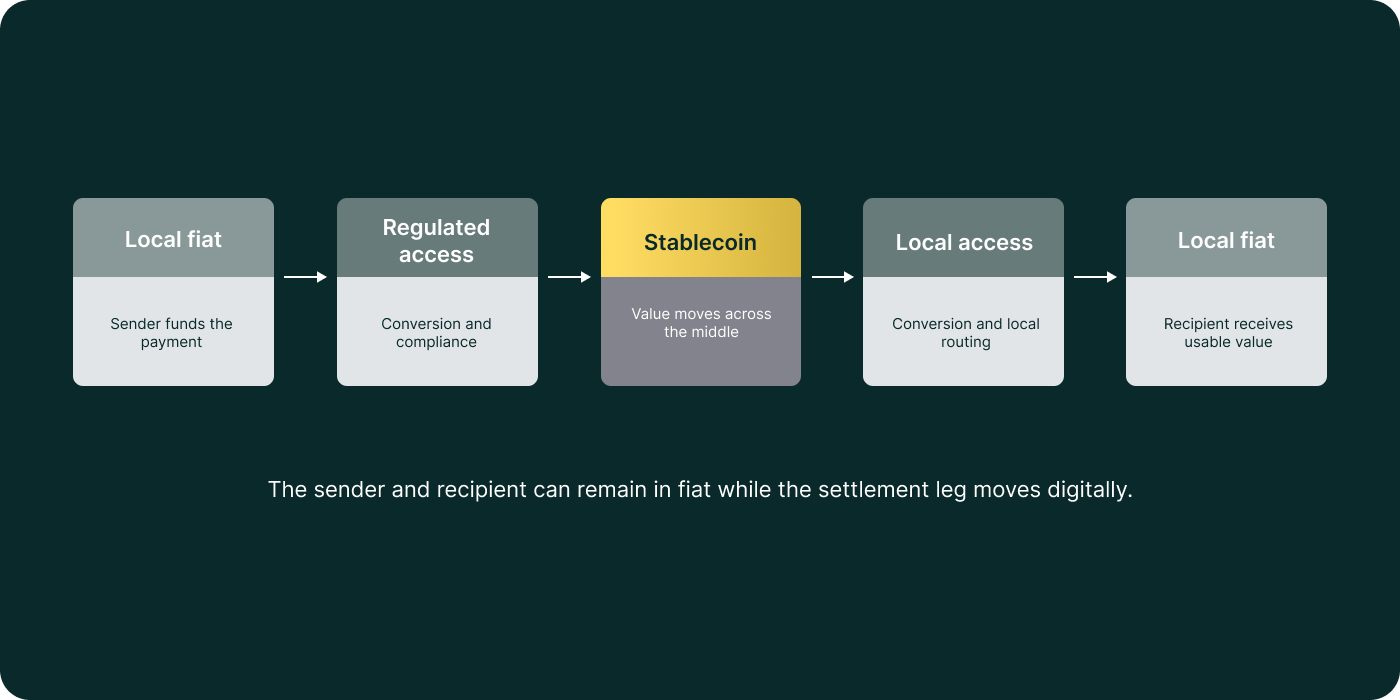
A stablecoin sandwich is a cross-border payment with fiat currency at both ends and a stablecoin in the middle. The sender does not need to hold a stablecoin, and the recipient does not need to receive one.
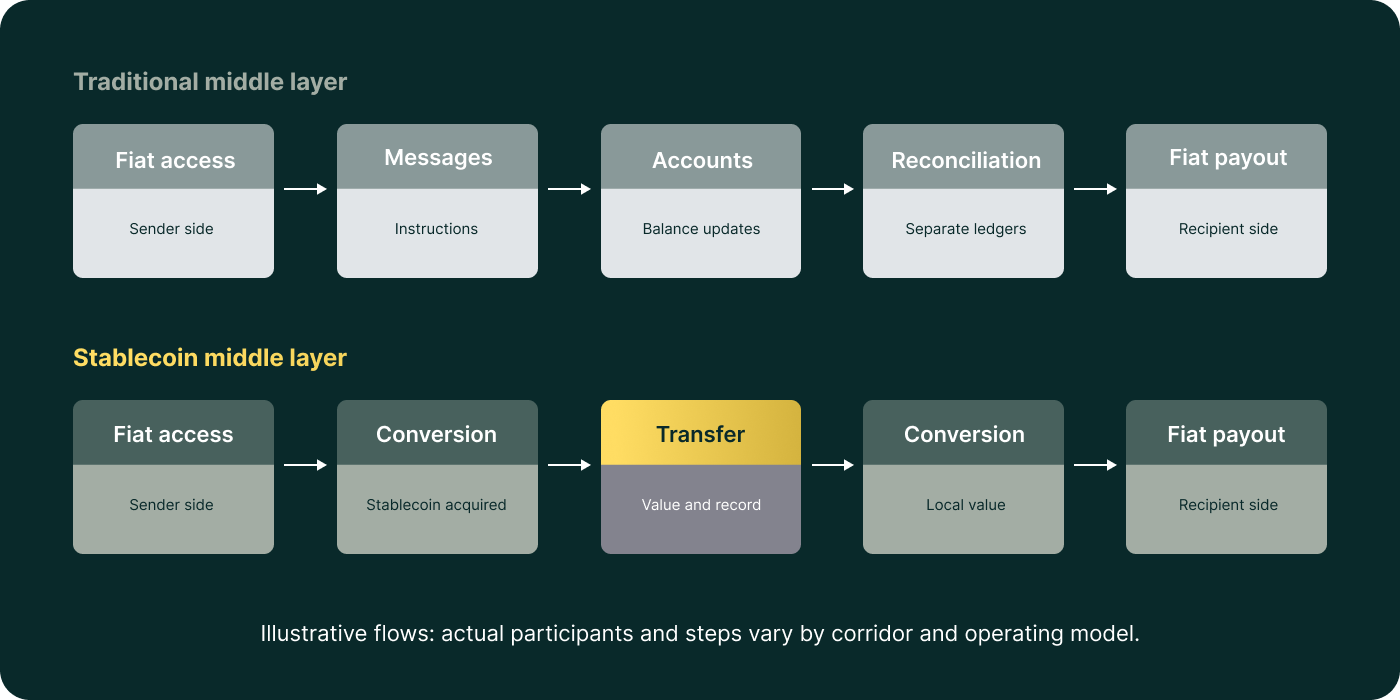
The model matters because a payment instruction can move instantly while settlement behind it still depends on correspondent accounts, operating hours and separately reconciled ledgers. The stablecoin targets that middle leg: how value moves between the two regulated endpoints.
The IMF estimated cross-border stablecoin flows at about USD 1.5 trillion in 2024, while noting that geographic flows are difficult to measure because public blockchains do not directly reveal where the parties are based. Its estimate of nearly USD 1 quadrillion refers to the much broader global market for traditional and crypto cross-border payments in 2024, so the figures are not directly comparable.
For a matched 2025 view, FXC Intelligence and Allium estimate that stablecoins accounted for approximately 0.31% of USD 44.3 trillion in retail cross-border payments. Their methodology filters out exchange deposits and other non-payment activity, providing a narrower measure of real-world payment use.
How the transaction works
The sender first provides local fiat to a regulated bank, payment provider or other authorised partner. That provider converts the funds into the appropriate stablecoin and transfers it on-chain to a regulated counterparty in the destination market.
At the destination, the stablecoin is converted into local fiat or a permitted local-currency payment token. The recipient is then credited through a wallet, bank account or domestic payment rail. Customer due diligence, sanctions screening and transaction monitoring remain in place at the relevant stages.
The middle can move faster than the edges
With stablecoin settlement, value and the transaction record can move together on shared, always-on infrastructure. This can reduce sequential balance updates, improve visibility and simplify reconciliation between institutions.
An on-chain confirmation is not the same as a completed payment. The destination provider still needs sufficient liquidity, a compliant conversion route and a currency or asset the recipient can legally use or redeem.
“The stablecoin changes the connective tissue between these institutions. It does not make the institutions unnecessary.”
Juha Viitala, Senior Executive Officer, Universal
What the settlement layer can improve
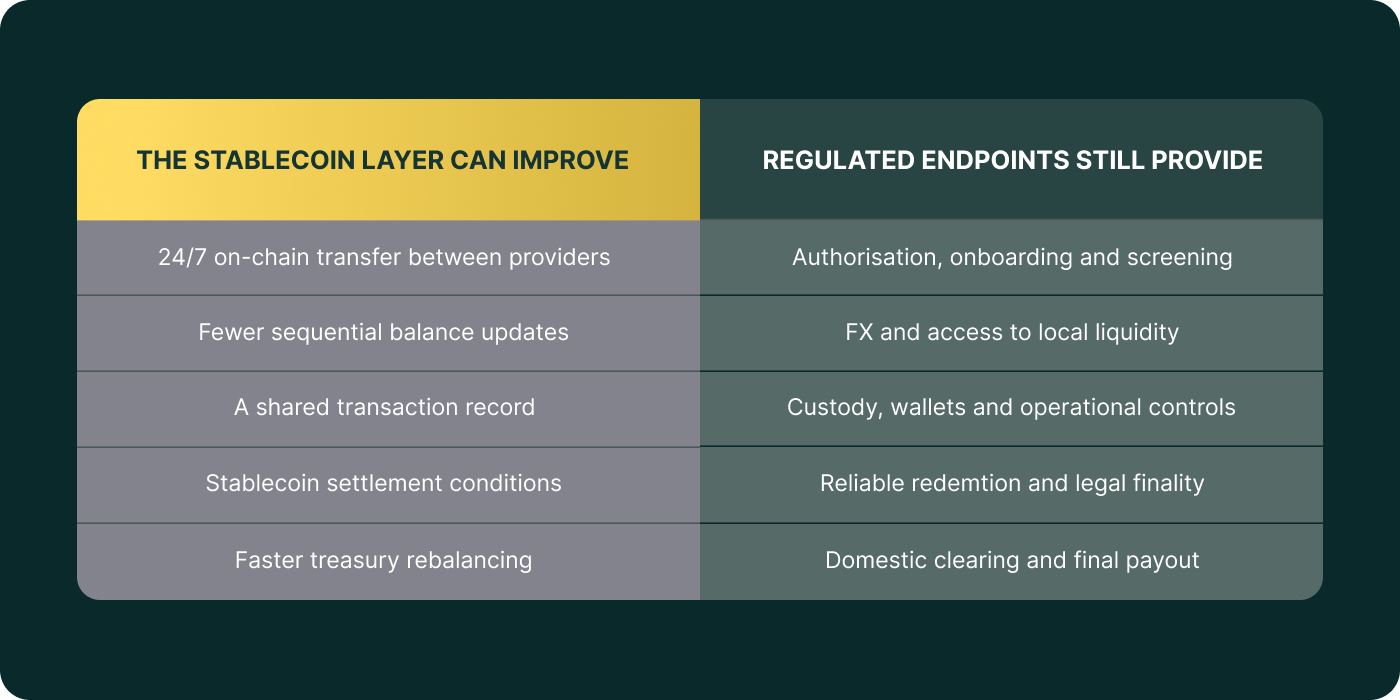
The potential benefits are practical: faster availability of funds, clearer transaction status, simpler reconciliation and more flexible liquidity movement. Stablecoin settlement can also connect payment to an invoice, delivery event or other verified condition.
These benefits are not automatic. Foreign-exchange spreads, on- and off-ramp fees, local liquidity, counterparty quality and dependable redemption still shape the end-to-end economics.
Banks and payment providers remain central
Banks may safeguard reserve assets, connect stablecoins to fiat, provide foreign exchange and support domestic clearing. Payment providers manage customer access, screening, routing, reconciliation and final payout. Custodians and wallet providers secure the asset, while liquidity providers support dependable conversion.
The strongest model is therefore hybrid: regulated financial institutions at the edges and a digital settlement asset in the middle.
The destination currency still matters
A cross-border payment is useful only when the value becomes usable at its destination. A USD-backed stablecoin can move value internationally, but salaries, suppliers, taxes and everyday purchases are generally denominated in local currency.
A regulated local-currency payment token can provide the digital cash leg for the destination market. It can support local liquidity and align the final payment with domestic rules. The CPMI identifies the peg currency and reliable on- and off-ramps as two of the most important design considerations for cross-border stablecoin arrangements.
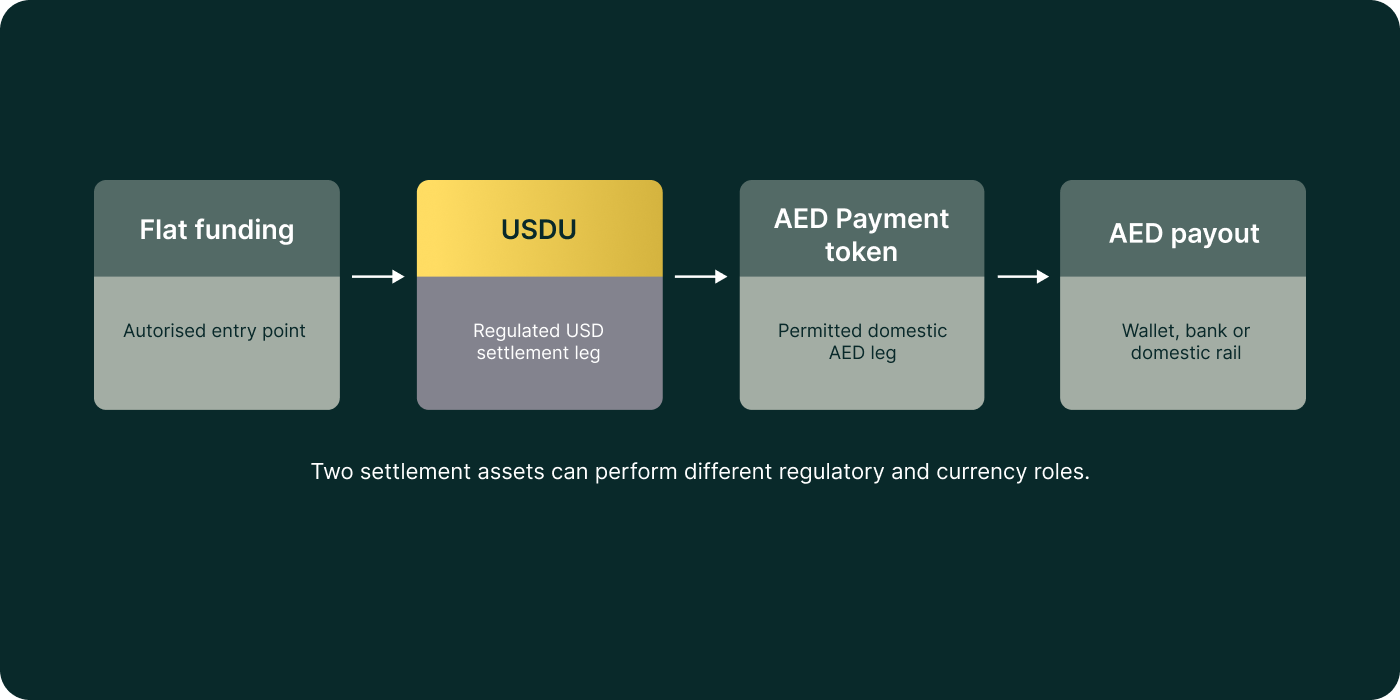
Pairing the two creates a two-token version of the sandwich: fiat funding, USD stablecoin, local-currency payment token and local fiat where required. Conversion can take place close to the point of use, where local liquidity and regulatory permissions are clearest.
How the UAE model could work
USDU and an AED-backed payment token can perform separate roles. USDU is issued by Universal, which is regulated by the ADGM Financial Services Regulatory Authority to issue a Fiat-Referenced Token to Professional Clients. USDU is also registered with the Central Bank of the UAE as a Foreign Payment Token under the Payment Token Services Regulation.
Within the mainland UAE, USDU is positioned for settlement connected to virtual-asset and virtual-asset-derivative activity. It is not a general-purpose domestic payment instrument. An AED-backed payment token such as AE Coin can provide the AED leg where domestic AED payment-token use is permitted. AE Coin and USDU have announced a regulated AED–USD conversion framework, powered by Al Maryah Community Bank, with initial access to be provided through Changer.ae and Aquanow. Any workflow would need appropriately authorised conversion and transfer providers and would remain subject to the rules applying to each participant and transaction.
The on-chain transfer is only one leg
The most common misunderstanding is that an on-chain transfer completes the whole payment. It does not. A complete transaction still requires compliant access, reliable conversion, sufficient liquidity and a destination asset the recipient can use or redeem.
Stablecoins also differ materially. The place of issuance, reserve assets, redemption rights, regulatory status and permitted uses all matter. USDU is backed 1:1 by liquid USD reserves held with Emirates NBD and Mashreq, with monthly independent attestations by Crowe Mak LLP. Those features support the settlement asset; they do not remove the need for regulated access or local payout infrastructure.
Where the model fits first
The clearest near-term use cases are cross-border B2B settlement, treasury transfers across time zones, and digital or tokenised-asset markets that need an on-chain cash leg. These are environments where better settlement visibility, shorter funding windows and more flexible liquidity movement can improve operations.
The objective is not to put every payment on-chain. It is to use a regulated digital settlement layer where the middle of the transaction creates the most friction, while banks and licensed providers continue to manage the financial controls and local-currency access at both ends. For the UAE, the question is not whether value will move on-chain, but whether the settlement layer in the middle is regulated, onshore and connected to AED at the edge.
About Universal
Universal Digital Intl Limited (“Universal”) is established in the Abu Dhabi Global Market and regulated by the Financial Services Regulatory Authority to issue a Fiat-Referenced Token to Professional Clients only. Universal is the issuer of USDU, which is registered with the Central Bank of the UAE as a Foreign Payment Token under the Payment Token Services Regulation.
USDU is designed for USD settlement in connection with virtual-asset and virtual-asset-derivative activity, not as a general-purpose domestic payment instrument in the UAE. Access is subject to regulatory and eligibility requirements. Licensing or registration does not imply endorsement.
Learn more universal.ae
Sources
International Monetary Fund December 2025 Understanding Stablecoins
International Monetary Fund · June 2025 Global Cross-Border Payments: A $1 Quadrillion Evolving Market?
FXC Intelligence and Allium · July 2026 How Big Is Stablecoins’ Share of Cross-Border Payments?
Bank for International Settlements June 2025 The next-generation monetary and financial system
Committee on Payments and Market Infrastructures October 2023 Considerations for the use of stablecoin arrangements in cross-border payments
Central Bank of the UAE accessed September 2026 Payment Token Services Regulation
ADGM Financial Services Regulatory Authority accessed September 2026 Universal Digital Intl Limited public register entry
Universal 29 January 2026 Universal launches the UAE’s first Central Bank-registered USD stablecoin
Universal accessed September 2026 USDU product and transparency information
