
The Hidden Cost of Cross-Border Payments
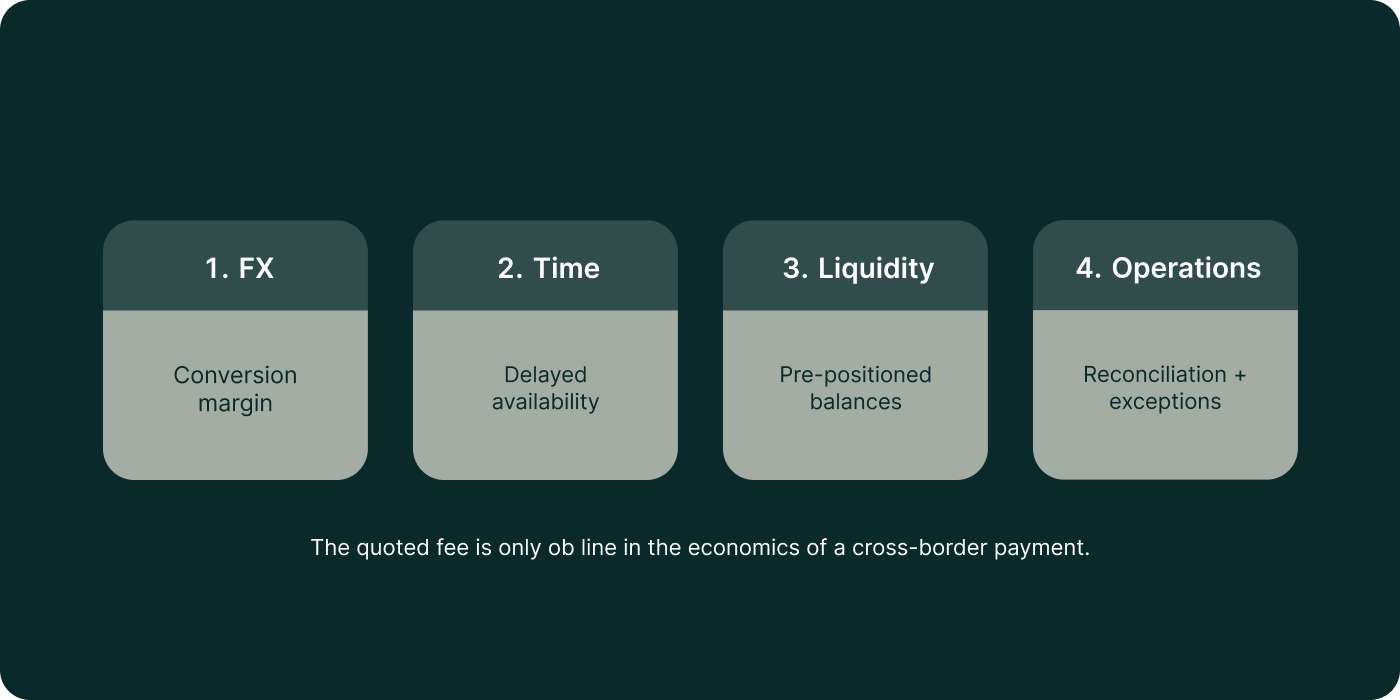
The quoted fee is only one part of a cross-border payment. FX margins, receiver-side charges, settlement delays, pre-funded liquidity and reconciliation all add to the true enterprise cost.
The invoice amount is not the true cost
For treasury teams, the all-in cost of an international payment spans the FX rate, downstream fees, settlement time and liquidity positioned before funds can move.
That makes cross-border payment costs harder to see than domestic fees. Some appear on the transaction; others sit in the exchange rate, payment route or balance sheet. For institutions moving money repeatedly across corridors, these hidden costs can outweigh the headline transfer fee.
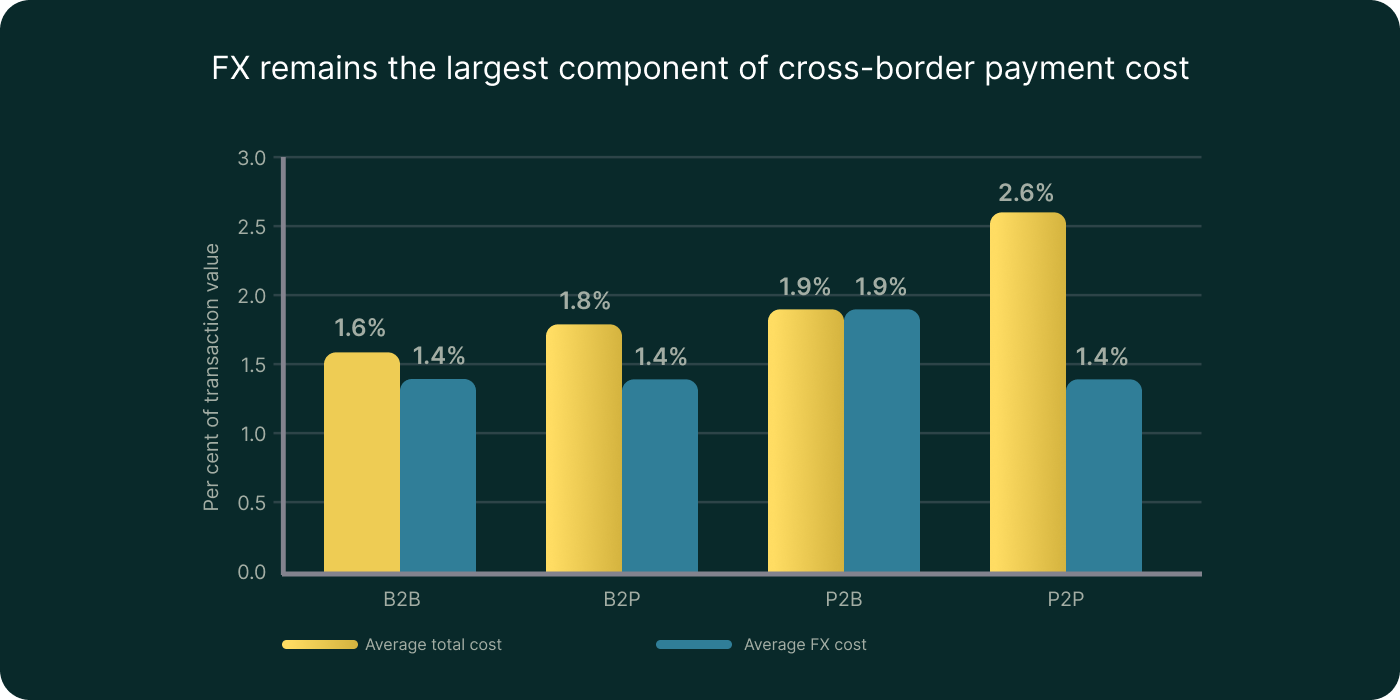
FSB data for 2025 illustrate the gap: the average cost of B2B cross-border payments was 1.6% of transaction value. FX accounted for 1.4 percentage points, or 87.1% of the total.
FX is the largest cross-border payment cost
Currency conversion often drives the economics of an international payment. In the FSB's 2025 dataset, FX was the largest average cost component across every measured use case.
Comparing payment providers on transfer fees alone can therefore mislead. Treasury teams should also assess the executable FX rate, available currencies, where conversion occurs and whether the beneficiary needs another conversion before using the funds.
The practical implication: For enterprise cross-border payments, better FX execution can matter more than eliminating the visible transfer fee.
Faster cross-border settlement does not automatically mean lower cost. FX, local-currency access and liquidity still shape the all-in price.
Receiver-side fees can reduce the amount delivered
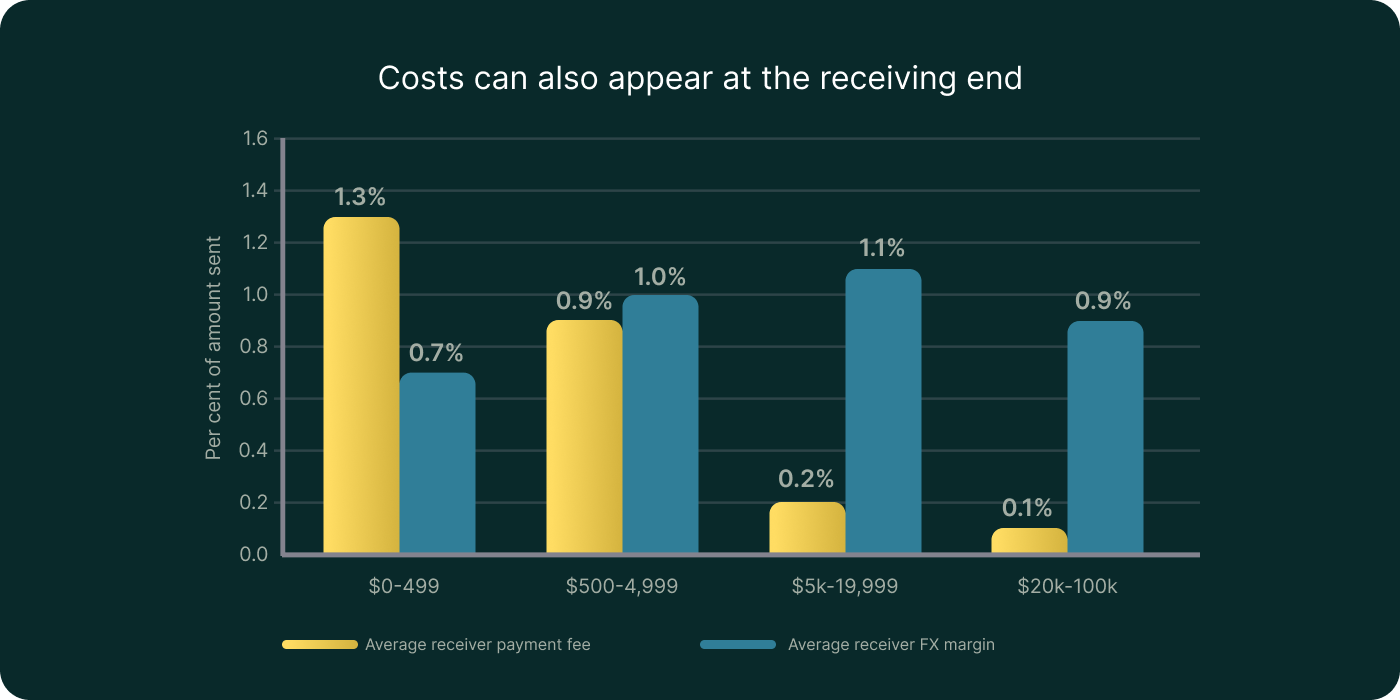
Costs can also appear downstream. Receiver-side payment fees and additional FX margins can reduce the amount ultimately available to the beneficiary.
Settlement time is a treasury cost
Settlement delays affect working capital, cash forecasting and the liquidity held as a buffer.
For corporate treasury teams, the issue is not simply whether a payment arrives the same day. It is whether funds are available when needed, whether status is visible end to end and how much contingency liquidity must remain in place while settlement is in progress.
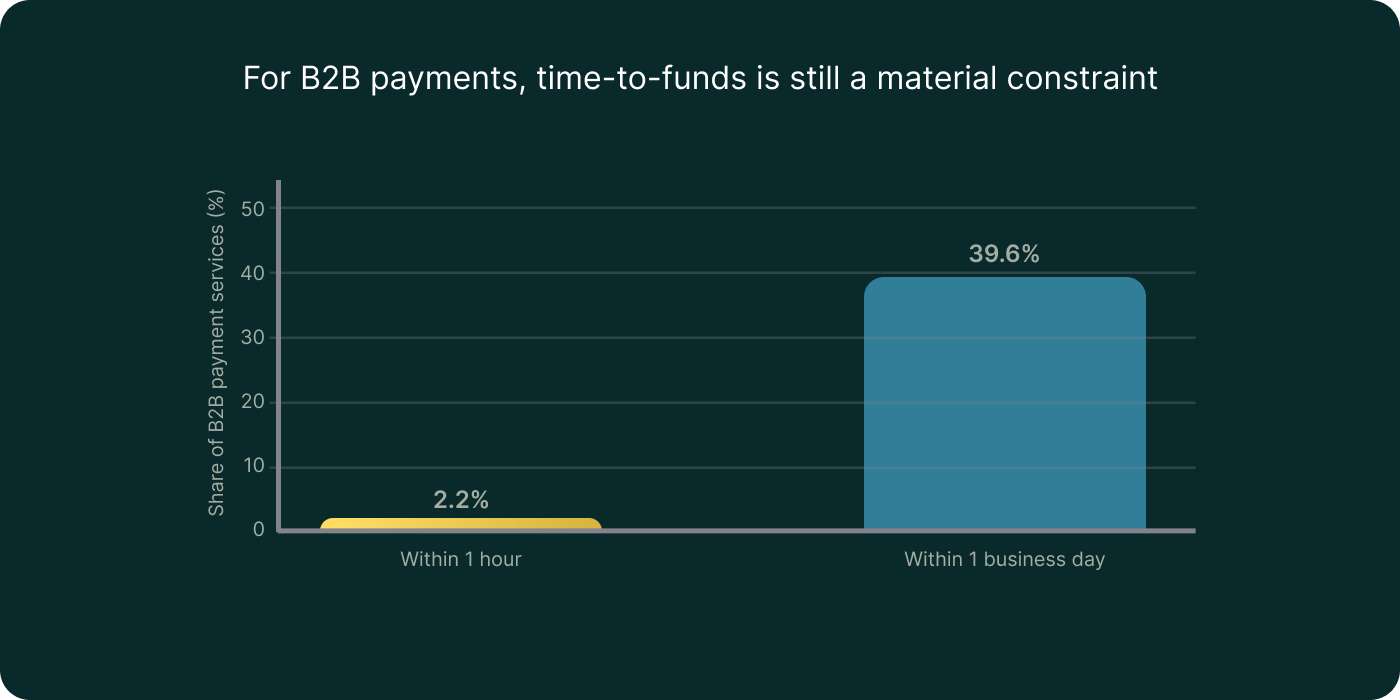
In the FSB's 2025 sample, only 2.2% of B2B retail cross-border payment services credited recipients within one hour. The G20 target is for 75% of cross-border retail payments to make funds available to recipients within one hour, with the remainder within one business day, by end-2027.
Why cross-border liquidity gets trapped
Another cross-border payment cost sits behind the transaction: liquidity. Multiple intermediaries, operating windows and local settlement requirements can force institutions to hold balances across accounts, currencies and corridors.
The BIS describes this as a structural treasury problem: fragmented liquidity and sequential account updates can leave capital distributed across corridors, with less flexibility to reuse it elsewhere.
Pre-funding can make a payment corridor reliable, but it has an opportunity cost. Cash held across currencies or accounts cannot be deployed elsewhere. The more markets, counterparties and operating windows involved, the more complex the liquidity picture.
The hidden cost is a system, not a line item
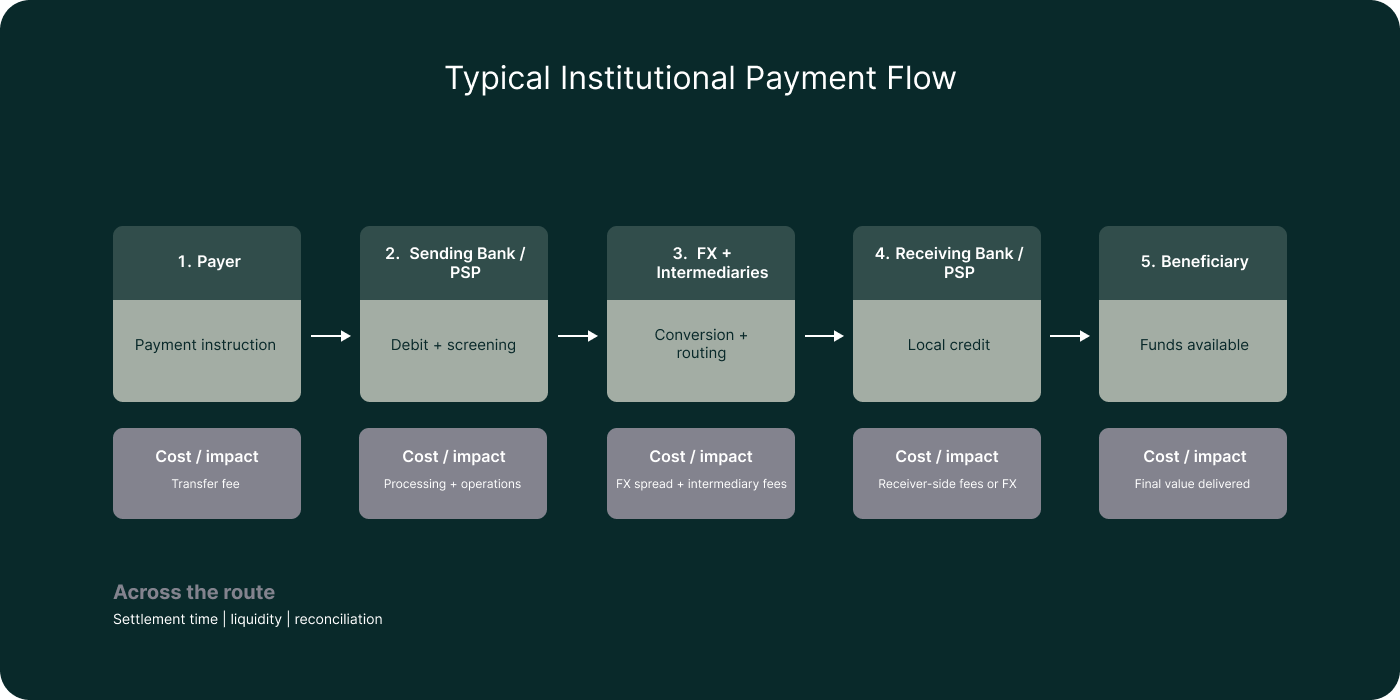
Where regulated stablecoins reduce payment friction
A regulated stablecoin does not remove FX, compliance, banking, custody or local-currency requirements. It can, however, change where some cross-border payment friction sits.
When value and its transaction record move together on always-on infrastructure, institutions can gain faster visibility, reduce sequential settlement steps and move liquidity beyond traditional operating windows. The IMF notes the potential for faster, lower-cost international payments, with appropriate safeguards.
The value is not that every cost disappears. FX still has a price, local payouts still require access to domestic payment rails, and regulated intermediaries still perform critical functions. The opportunity is to compress selected settlement steps and make value transfer easier to track and reconcile.
What digital settlement can improve
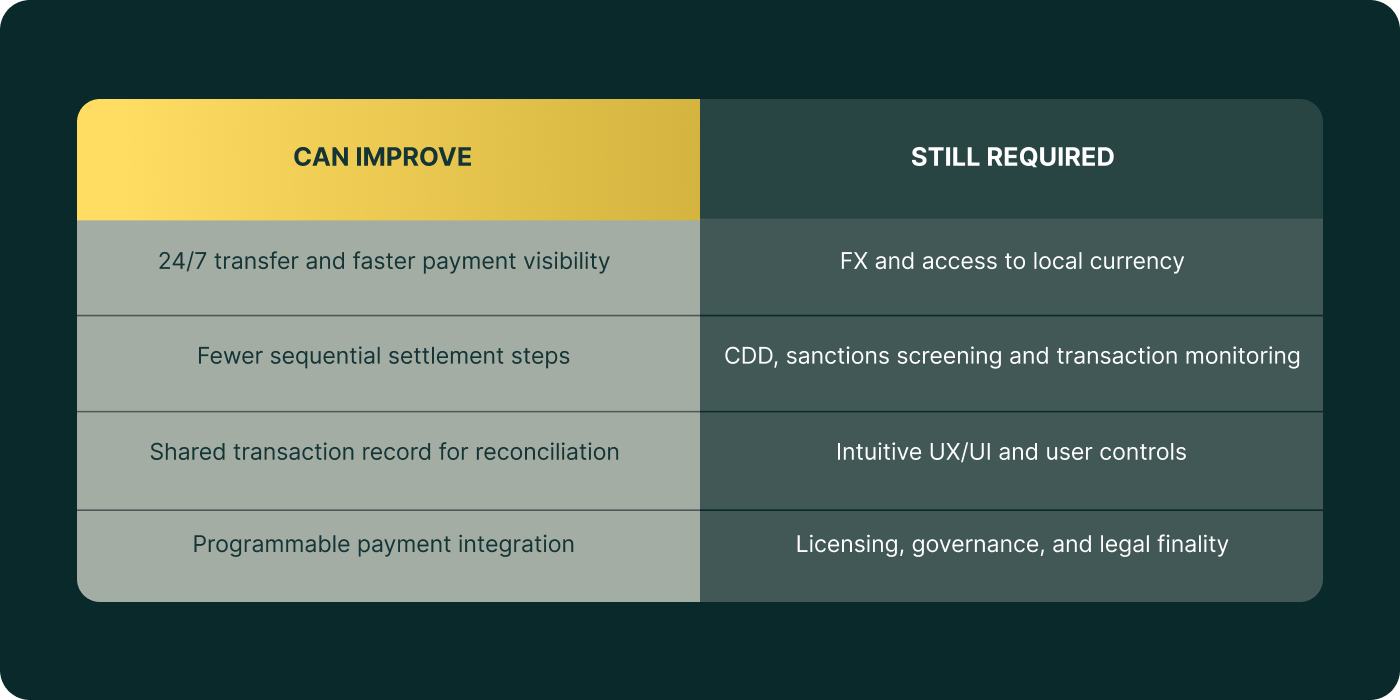
Where cross-border payment economics improve
The clearest near-term use cases are where several hidden costs overlap: cross-border B2B payments, treasury transfers across time zones, and digital or tokenised-asset markets that need an on-chain cash leg.
These are environments where a few hours of delay, an extra FX conversion or additional pre-funded liquidity can affect operations. With established compliance, custody and treasury processes in place, targeted settlement improvements may be more practical than replacing existing payment systems wholesale. The objective is not to move every payment on-chain, but to reduce friction on settlement legs where timing, liquidity and reconciliation matter most, while regulated institutions continue to provide the surrounding financial controls.
Sources
Financial Stability Board, 9 October 2025 - G20 Roadmap for Enhancing Cross-border Payments: Consolidated progress report for 2025. https://www.fsb.org/2025/10/g20-roadmap-for-cross-border-payments-consolidated-progress-report-for-2025/
Bank for International Settlements, 24 June 2025 - Annual Economic Report 2025, Chapter III: The next-generation monetary and financial system. https://www.bis.org/publ/arpdf/ar2025e3.htm
Financial Stability Board, last updated 21 March 2025 - G20 Targets for Enhancing Cross-border Payments. https://www.fsb.org/work-of-the-fsb/financial-innovation-and-structural-change/cross-border-payments/g20-targets-for-enhancing-cross-border-payments-2/
International Monetary Fund, 4 December 2025 - Understanding Stablecoins, Departmental Paper No. 2025/009. https://www.imf.org/en/publications/departmental-papers/issues/2025/12/02/understanding-stablecoins-570602
ADGM Financial Services Regulatory Authority, 31 October 2025 - FSRA finalises regulatory framework for Regulated Activities involving Fiat-Referenced Tokens. https://www.adgm.com/media/announcements/adgm-fsra-finalises-regulatory-framework-for-regulated-activities-involving-fiat-referenced-tokens
ADGM Financial Services Regulatory Authority, accessed 25 August 2026 - Universal Digital Intl Limited firm profile, FSP No. 250089. https://www.adgm.com/api/FSRAC_FirmPdf/GenerateFirmProfilePdf?FirmId=165868
Central Bank of the UAE, 2026 - Thematic Review of Providers of Stored Value Facilities, Retail Payment Services and Card Schemes and Payment Token Services. https://www.centralbank.ae/media/0tkpisux/thematic-review-of-providers-of-stored-value-facilities-retail-payment-services-and-card-schemes-and-payment-token-services.pdf
Universal, 29 January 2026 - Universal Launches UAE's First Central Bank-Registered USD Stablecoin. https://www.universal.ae/news/universal-launches-uaes-first-central-bank-registered-usd-stablecoin
Central Bank of the UAE, accessed 25 August 2026 - Payment Token Services Regulation. https://rulebook.centralbank.ae/en/rulebook/payment-token-services-regulation
About Universal
Universal Digital Intl Limited (“Universal”) is established in the Abu Dhabi Global Market (ADGM) and regulated by the Financial Services Regulatory Authority (FSRA) to conduct the regulated activity of issuing a Fiat-Referenced Token.
Universal is the issuer of USDU, a fully USD-backed stablecoin designed to support secure, transparent, and regulated digital asset settlement. USDU is registered with the Central Bank of the UAE (CBUAE) as a Foreign Payment Token under the Payment Token Services Regulation.
Built on a strong regulatory foundation and supported by trusted institutional partnerships, Universal is advancing resilient digital value infrastructure designed to support the evolving needs of global financial markets.
Learn more at www.universal.ae
