
Real Estate Tokenisation in MENA: From Concept to Market Infrastructure
Real estate tokenisation in the MENA region is moving decisively beyond concept.
Over the past two years, a series of government-led initiatives and market developments, particularly in the UAE, have shifted tokenisation from experimentation towards early-stage deployment. What is emerging is not simply a new way to fractionalise property, but a broader transformation in how real estate is accessed, financed, and settled.
From Pilot to Market Design
Dubai has taken a leading role in translating tokenisation into real market activity.
In 2025, the Dubai Land Department launched the pilot phase of its Real Estate Tokenisation Project, introducing blockchain-based structures that enable fractional ownership of property. This was followed by the rollout of early tokenised investment opportunities.
More recently, the initiative has progressed further with the introduction of secondary market functionality, allowing investors to resell tokenised property stakes, a critical step toward improving liquidity.
Taken together, these developments signal a clear direction. Tokenisation is no longer being treated as a standalone innovation, but as an extension of real estate market infrastructure.
Building the Institutional Layer
In parallel, Abu Dhabi is advancing the institutional foundations required to support tokenised assets at scale.
Through ADGM, initiatives such as digital real property platforms are focused on improving transparency, ownership tracking, and operational efficiency.
This complements Dubai’s approach, creating a dual-track evolution:
• an access layer, enabling broader participation in real estate investment
• an infrastructure layer, supporting regulated issuance and institutional-grade products
Together, these layers begin to form a more integrated digital real estate market.
Beyond Fractional Ownership
Much of the discussion around tokenisation continues to centre on accessibility, the ability to divide property into smaller, investable units.
While relevant, this is only part of the story.
The more meaningful shift lies in how tokenisation begins to reshape the underlying mechanics of the market:
• more flexible entry and exit
• emerging secondary market activity
• increased cross-border participation
• reduced operational friction in asset transfer
In this context, tokenisation is less about fractional ownership and more about market efficiency and connectivity.
Importantly, emerging models are not limited to fractionalisation - they can represent structured real estate exposure (e.g. digital REIT-like models), where tokenisation reflects the vehicle rather than dividing a single asset.
The Role of Stablecoins in Tokenised Real Estate
As tokenised real estate evolves, a more fundamental question emerges: how are these transactions settled?
Traditional real estate transactions rely on fragmented and often slow payment infrastructure, particularly across borders. This becomes increasingly misaligned with a tokenised environment, where transaction frequency rises and investor bases become more global.
This is where digital settlement mechanisms begin to play a role.
Stablecoins, as digital representations of fiat currency, can support more efficient settlement within digital asset markets. They enable:
• near real-time settlement between market participants
• more efficient cross-border value transfer (where permitted)
• reduced reliance on correspondent banking layers
• closer alignment between trading activity and settlement infrastructure
Beyond transaction settlement, tokenised structures can also enable more efficient distribution of income streams - such as rental yields - through digital rails.
In effect, stablecoins are emerging as a settlement layer within digital asset markets, supporting the speed and flexibility required by tokenised ownership structures.
Within the UAE, this role is more specifically defined. Under the Payment Token Services Regulation (PTSR), payment for virtual assets and derivatives must be conducted using fiat or Central Bank-registered Foreign Payment Tokens, positioning instruments such as USDU within that framework.
A Region Positioned for Early Adoption
MENA’s role in this transition is not incidental.
The region combines several structural advantages:
• deep, globally connected real estate markets
• active government involvement in digital asset development
• established regulatory frameworks for tokenised assets
• increasing institutional participation in digital finance
While other jurisdictions are still exploring tokenisation, the UAE stands out for advancing multiple components of the ecosystem simultaneously, from land registry initiatives to digital asset regulation and payment infrastructure.
The Direction of Travel
Real estate tokenisation in MENA remains at an early stage, but the trajectory is increasingly clear.
The next phase will not be defined solely by new pilots, but by integration - connecting tokenised assets with:
• regulated trading venues
• institutional capital flows
• trusted digital settlement mechanisms
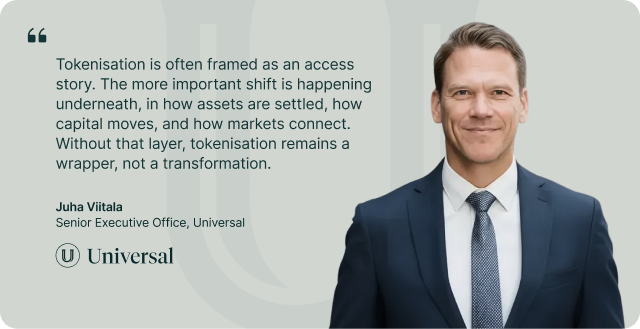
From Innovation to Infrastructure
Tokenisation alone does not transform real estate markets.
But combined with regulated infrastructure, particularly digital settlement mechanisms, it begins to reshape how ownership is structured, how capital moves, and how markets function.
In MENA, that transition is already underway.
The shift is gradual, but directional.
From concept to pilot, and now, increasingly to infrastructure.
RESOURCE INDEX
• Dubai Land Department – Pilot phase of the Real Estate Tokenisation Project
https://dubailand.gov.ae/en/news-media/dubai-land-department-launches-pilot-phase-of-the-real-estate-tokenisation-project
• Dubai Land Department – Prypco Mint tokenised real estate project
https://dubailand.gov.ae/en/news-media/dld-launches-the-mena-s-first-tokenized-real-estate-project-through-the-prypco-mint-platform
• Dubai Land Department – Phase II secondary market functionality
https://dubailand.gov.ae/en/news-media/dubai-land-department-launches-phase-ii-of-the-real-estate-tokenisation-project-enabling-resale-in-the-secondary-market-from-20-february
• ADGM – Digital real property platform initiative
https://www.adgm.com/media/announcements/adgm-partners-with-adres-to-develop-a-state-of-the-art-digital-real-property-platform
About Universal
Universal Digital Intl Limited (“Universal”) is established in the Abu Dhabi Global Market (ADGM) and regulated by the Financial Services Regulatory Authority (FSRA) to conduct the regulated activity of issuing a Fiat-Referenced Token.
Universal is the issuer of USDU, a fully USD-backed stablecoin designed to support secure, transparent, and regulated digital asset settlement. USDU is registered with the Central Bank of the UAE (CBUAE) as a Foreign Payment Token under the Payment Token Services Regulation.
Built on a strong regulatory foundation and supported by trusted institutional partnerships, Universal is advancing resilient digital value infrastructure designed to support the evolving needs of global financial markets.
Learn more at www.universal.ae
