
How Regulated Stablecoins Are Reshaping Cross-Border Settlement
Cross-border payments can be initiated in seconds, yet the underlying value may still take hours or days to settle. Regulated stablecoins are emerging as a shared settlement layer that can close that gap - while keeping banks, compliance and fiat rails firmly in the model. For UAE-linked flows, the domestic payment leg also requires an AED-backed stablecoin within the applicable local framework.
Settlement, not just payment
Cross-border payments are usually judged by what the user sees: how quickly an instruction is sent and how quickly a confirmation arrives. But confirmation is not settlement. In UAE-linked flows, the end-to-end process also includes conversion into an AED-backed stablecoin where a domestic payment leg is required.
The underlying value may still need to move through correspondent accounts, sequential balance updates, reconciliation processes and operating windows that stop at weekends. The message travels quickly. The money often does not.
Regulated stablecoins address this gap at the infrastructure layer. They allow value and its transaction record to move together over shared, always-on infrastructure. They do not remove the institutions around a cross-border transaction; they can give those institutions a common settlement asset and a common record of transfer. Where the flow enters the UAE domestic payment system, that model also requires interoperability with an AED-backed stablecoin for the local-currency leg.
How the model works
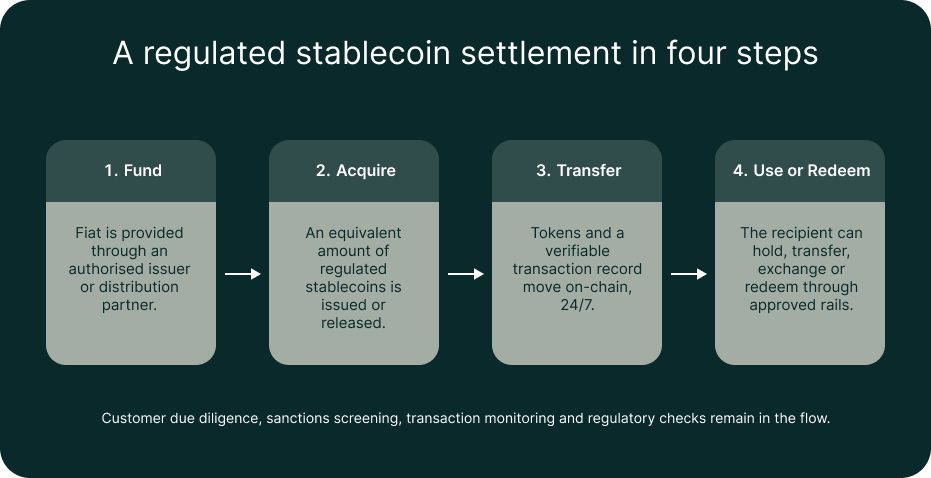
A regulated stablecoin settlement is more straightforward than the terminology suggests. The sender funds the transaction through an authorised issuer or distribution partner. An equivalent amount of stablecoins is issued or released, transferred over a blockchain and recorded on a shared ledger. The recipient can then hold the asset, use it in another permitted transaction, exchange it or redeem it for fiat through an approved channel.
The important point is not that every intermediary disappears. It is that several sequential messages, balance updates and reconciliation steps can be replaced by a direct transfer of value with a verifiable, timestamped record.
What changes - and what does not
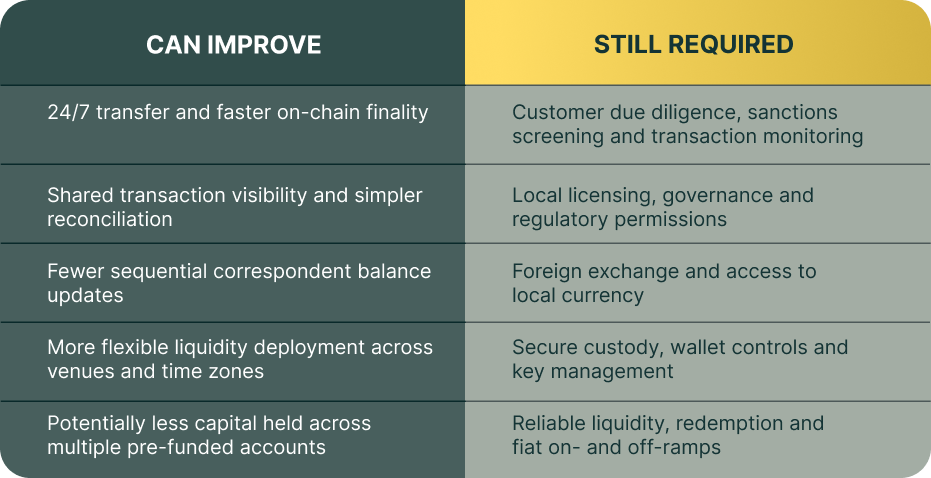
The strongest case for stablecoins is targeted efficiency, not wholesale replacement. They can remove friction from the parts of a cross-border journey that are slowest or most fragmented, while leaving core financial controls in place. For UAE-linked flows, this includes connecting the USD settlement leg with an AED-backed stablecoin where domestic payment settlement is required.
Liquidity may be the bigger prize
Behind every international payment sits a less visible cost: pre-funding. Financial institutions often hold balances across multiple countries and currencies so payments can be completed locally. That capital remains dispersed across corridors, frequently idle but always carrying a cost.
Stablecoins do not eliminate pre-funding. Institutions, payment providers and market makers may still need to position stablecoins or local currency, especially in less liquid corridors. The opportunity is to consolidate liquidity into fewer, more flexible pools, move it closer to the point of need and reuse it more quickly across transactions and markets.
Near-real-time visibility over balances and transfers can also help treasury teams forecast liquidity needs, automate funding decisions and reduce the capital maintained purely as a settlement buffer.
Finality has three layers
For institutions, an on-chain confirmation is necessary but not sufficient. Settlement is meaningful only when the transfer is technically complete, legally recognised and economically usable.
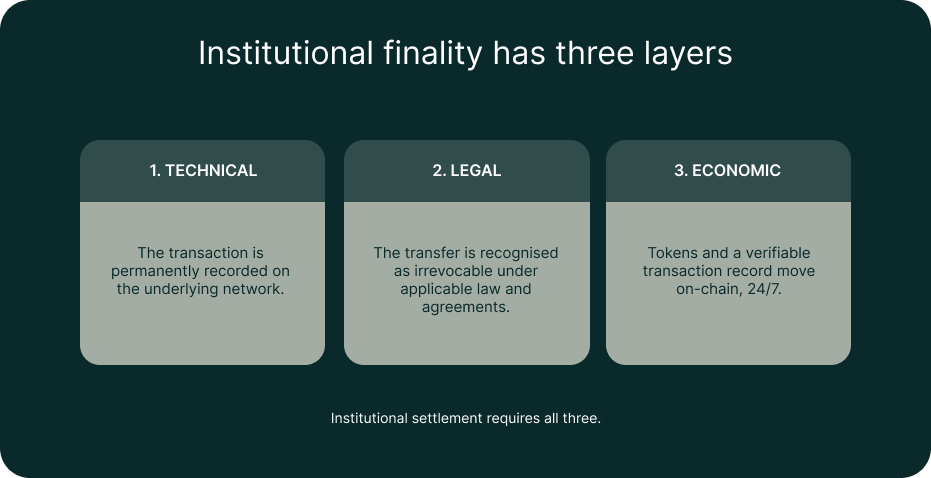
This is why issuer status, reserve quality, independent attestation, redemption rights, applicable law and market liquidity matter as much as blockchain speed. Regulation and 1:1 backing can strengthen the foundation, but legal and economic finality also depend on contracts, jurisdiction, available liquidity and the recipient's ability to use or redeem the asset at its expected value.
The winning model is hybrid
Banks remain central to stablecoin settlement. They safeguard reserves, support issuance and redemption, provide foreign exchange and connect the model to domestic clearing systems. Payment providers manage onboarding, screening, routing and local payouts. Custodians secure the asset. Treasury teams integrate stablecoin balances into existing cash-management processes.
The stablecoin acts as the shared value-transfer layer between these systems. APIs connect that layer to enterprise resource planning, treasury and accounting platforms, allowing institutions to introduce an always-on settlement rail without abandoning the controls and relationships they already rely on.
That combination is the point: stablecoins can improve the movement, visibility and programmability of value; regulated institutions provide the reserves, compliance, liquidity, redemption and local-currency access that make the model usable.
What institutions need to scale
Regulatory readiness. Institutions need clarity on whether they may hold and use a particular stablecoin in every relevant jurisdiction. That includes the permissions of the issuer and service providers, customer and transaction controls, reserve disclosures and redemption terms.
Operational readiness. Treasury and finance teams need clear processes to acquire, hold, transfer, value, reconcile and redeem stablecoins, including outside normal banking hours. Banking relationships, liquidity providers and fiat access remain part of the design.
Technical readiness. Secure custody, wallet permissions, key management and integration with payment, treasury and accounting systems are baseline requirements. Institutions must also assess the underlying network for security, availability, finality, transaction costs and smart-contract risk.
Where the opportunity is clearest
The strongest near-term use cases are those where settlement friction is already expensive: cross-border B2B payments and treasury transfers, particularly in corridors that depend on multiple intermediaries or operate across time zones; digital-asset and tokenised-asset markets, where stablecoins can provide the cash leg for trading, collateral movement and delivery-versus-payment; and, over time, trade and supply-chain flows triggered by verified events or contractual conditions. In UAE-linked cross-border flows, the model also requires an AED-backed stablecoin for any domestic payment leg, connecting international USD settlement with local AED settlement within the applicable framework.
The opportunity is not simply to make the front end of a payment feel faster. It is to create a shared settlement layer that connects banks, payment providers, exchanges, asset platforms and corporate treasury systems with less structural friction - subject, in every case, to the rules that govern the asset, the participants and the transaction.
From concept to regulated infrastructure
Universal is putting this hybrid model into practice through USDU. Universal is regulated by the ADGM Financial Services Regulatory Authority to issue a Fiat-Referenced Token to Professional Clients and registered with the Central Bank of the UAE as a Foreign Payment Token Issuer. USDU is the first USD-backed stablecoin registered by the CBUAE as a Foreign Payment Token.
USDU is backed 1:1 by liquid U.S. dollar reserves held in reserve accounts with Emirates NBD and Mashreq, with independent attestations published monthly. It is designed for regulated USD settlement in connection with virtual assets and virtual asset derivatives, linking issuance, banking, custody, distribution and market infrastructure.
The broader lesson is clear: reserve quality, legal clarity, compliant access, custody, liquidity and reliable redemption are what turn an on-chain transfer into institutional settlement.
About Universal
Universal Digital Intl Limited (“Universal”) is established in the Abu Dhabi Global Market (ADGM) and regulated by the Financial Services Regulatory Authority (FSRA) to conduct the regulated activity of issuing a Fiat-Referenced Token.
Universal is the issuer of USDU, a fully USD-backed stablecoin designed to support secure, transparent, and regulated digital asset settlement. USDU is registered with the Central Bank of the UAE (CBUAE) as a Foreign Payment Token under the Payment Token Services Regulation.
Built on a strong regulatory foundation and supported by trusted institutional partnerships, Universal is advancing resilient digital value infrastructure designed to support the evolving needs of global financial markets.
Learn more at www.universal.ae
